
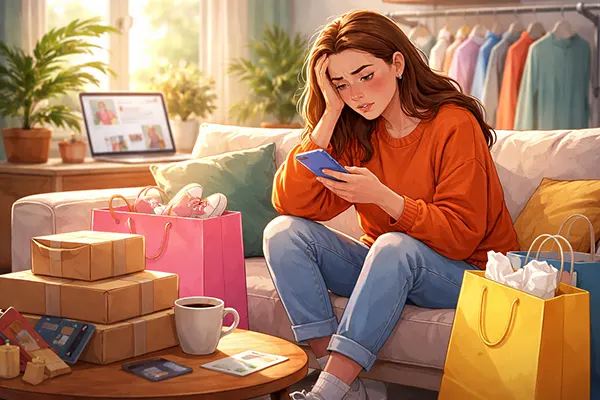
Comfort Shopping Psychology: How to Spot Stress Buying and Replace It with Healthier Rituals
Many people in 2026 live at a pace where emotions are managed in five-minute gaps: a quick coffee, a scroll, a last-minute order. Buying something “for comfort” can feel harmless, even practical — a small reward after a hard day. But there is a subtle line between a normal purchase and stress-shopping: the moment shopping becomes a fast emotional anaesthetic rather than a considered choice. Stress-shopping (also called compensatory shopping) is not about being “bad with money”. It is usually about emotion regulation. When the nervous system is overwhelmed, the brain searches for immediate relief and predictable rewards. Shopping provides both: anticipation, control, and a small dopamine hit. Understanding the mechanism is the first step to changing it without shame or extremes. This article explains how to recognise stress-shopping early, what triggers it most often, and how to replace it with healthier rituals that still give your mind what it is looking for: safety, comfort, and a sense of “I can cope”.
Normal Purchases vs “I Need This to Feel Better” Purchases
A normal purchase is connected to a real need or a planned preference. You might compare options, think about your budget, and feel neutral afterwards. A stress-driven purchase is usually connected to an emotional spike — anxiety, loneliness, fatigue — and the main goal is not the item itself, but the emotional shift you hope the item will produce.
A useful way to tell the difference is to look at the inner dialogue. In normal spending, thoughts sound like: “I need a charger” or “I’ve planned to replace these shoes.” In stress-shopping, the thought is more urgent and emotional: “I deserve something right now,” “I can’t cope without a treat,” “This will finally make me feel organised,” or “If I buy this, I’ll feel calmer.”
Another sign is the emotional “dip” afterwards. With stress-shopping, the relief tends to be short-lived. The nervous system settles for a moment, then guilt, disappointment, or a feeling of emptiness returns. Many people describe it as a loop: tension → purchase → brief relief → regret → more tension.
The Quick Self-Check: Three Questions Before You Buy
If you want a simple tool that works in real life, ask yourself three questions. First: “If I was calm right now, would I still want this?” Second: “What emotion am I trying to shift?” Third: “Will this purchase help in two weeks, or only in two hours?” These questions do not judge you — they simply bring awareness back online.
Pay attention to physical sensations too. Stress-shopping often comes with a restless body: tight chest, shallow breathing, clenched jaw, or that jittery “I have to do something” feeling. The purchase becomes a behaviour that discharges nervous energy. When you notice this, you can choose a different discharge ritual that is kinder to your wallet and your long-term wellbeing.
Also look at secrecy and speed. If you feel you need to hide the purchase, minimise it, or click “buy” quickly before you can think, that is a strong clue the purchase is serving an emotional function rather than a practical one.
Five Common Triggers of Stress-Shopping in 2025–2026
Stress-shopping rarely happens randomly. It is usually predictable. In 2026 the trigger landscape has become more intense because daily life is shaped by information overload, constant comparisons, and the feeling that you should always be improving. Shopping becomes a quick “fix” for self-worth, tiredness, or disconnection.
One major trigger is fatigue. When you are exhausted, the brain shifts into short-term thinking. Planning, restraint, and perspective require mental energy. That is why late-night shopping is so common: the brain wants comfort and low-effort rewards, and online stores are built to provide them instantly.
Another common trigger is loneliness. Purchases can mimic emotional connection: parcels arriving feel like attention, and browsing can feel like company. For some people, the routine of “choosing and receiving” temporarily replaces the feeling of being chosen and supported by others.
Deadlines, Boredom, and Social Media: The Underestimated Drivers
Deadlines create a specific kind of stress: pressure mixed with lack of control. When you cannot control the workload, you control a purchase. It can become a micro-rebellion — “I can’t change the deadline, but I can at least get this.” That is why people often buy things while procrastinating or after an intense work sprint.
Boredom is another powerful trigger. It is not always a lack of entertainment — sometimes it is emotional understimulation or avoidance. Browsing is stimulating, simple, and gives an illusion of productivity. The mind stays busy, and you do not have to feel whatever is underneath the boredom.
Social media is the final big trigger. In 2026, personalised ads and influencer content can create a constant sense of “you are missing something.” Even when you know it is marketing, repeated exposure increases desire. Stress-shopping becomes more likely when you scroll while tired, lonely, or emotionally raw, because your brain is more suggestible in those states.
The “24-Hour Pause” Technique and a Practical List of Substitutes
The goal is not to ban shopping. The goal is to separate emotional urgency from decision-making. The “24-hour pause” works because stress-shopping relies on immediacy. If you delay the purchase, the nervous system often resets, and you can decide with clearer thinking.
Here is how to do it in a realistic way. When you want to buy something quickly, add it to a wishlist or notes, then set a reminder for 24 hours. If the item is truly needed, you will still want it tomorrow — often with a more grounded feeling. If it was an emotional buy, the intensity usually drops sharply within a day.
To strengthen the technique, set a personal “comfort spending threshold”. For example: anything above £20 gets a pause, anything above £50 requires two pauses, and any purchase made after 10 pm is automatically postponed. This is not about restriction — it is about protecting yourself during vulnerable moments.
Healthy Rituals That Give the Same Emotional Relief (Without the Receipt)
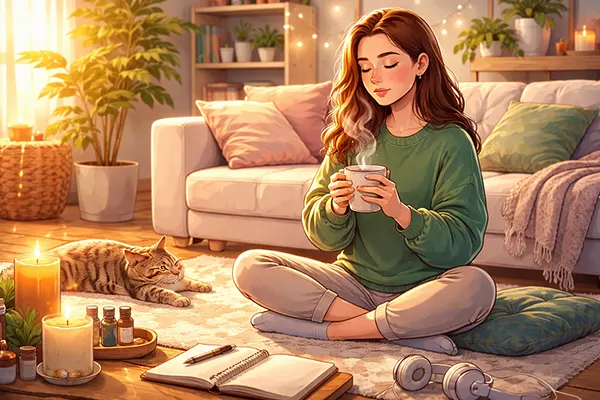
Stress-shopping usually tries to produce one of four feelings: comfort, control, reward, or identity. Your substitutes should target the same feeling. For comfort: a warm shower, a heated blanket, a slow cup of tea, a ten-minute breathing session, or calming music with eyes closed. These are not “small” — they directly signal safety to the nervous system.
For control: tidy one small area for five minutes, write a short plan for tomorrow, or do a “brain dump” list of worries. For reward: a favourite film, a short walk somewhere pleasant, a free activity you genuinely enjoy, or calling a friend. For identity: return to a hobby, style an outfit from what you already own, or update your environment in a non-spending way (rearranging a room can be surprisingly regulating).
It helps to keep a written “replacement menu” on your phone. In the moment, stress reduces creativity. If you already have a list, you can pick one quickly. The best replacements are the ones you can do in under 15 minutes and that create a clear shift in your body state — calmer breathing, slower heartbeat, less mental noise.