

Why Some Rituals Calm You More Than Rest
Rest should help, yet many people notice a strange thing: a ten-minute ritual can settle them faster than an entire free evening. That is not magic and it is not “just in your head”. A well-chosen ritual gives the nervous system predictable signals: what happens next, how long it will last, and what “safe” feels like. In 2026, when work and social life are fragmented by notifications, irregular schedules, and constant switching, that predictability is often the missing ingredient.
Predictability is a safety signal for the brain
Your brain is a prediction machine. Stress rises when it cannot reliably forecast what is coming, especially if you are already tired. A short ritual reduces uncertainty on purpose: the steps are known, the order is fixed, and the ending is clear. That gives your attention something stable to hold on to, which often feels more calming than “doing nothing” while your mind keeps scanning for the next demand.
Rest can fail when it is unstructured. Scrolling, half-watching a show, or lying on the sofa while thinking about tomorrow may look like downtime, but the brain still treats it as open-ended. No clear start, no clear finish, and plenty of cues that keep the threat system mildly active (messages, news, bright screens, unresolved tasks). In contrast, a ritual is bounded. Even if it is only making a drink and sitting by a window, the boundary matters.
Rituals also reduce decision fatigue. When you are depleted, even small choices can feel heavy: “What should I do now?”, “Should I go out?”, “Should I call someone?”, “Should I cook?” A ritual removes choices. You follow the script, and the sense of effort drops quickly. That drop in effort is often experienced as calm.
Why repetition changes how your body feels
Repeated sequences become “low-cost” for the brain. Over time, your body learns that certain cues predict a specific internal state. For example, the same mug, the same chair, and the same three-minute breathing pattern can become a reliable transition into a calmer baseline. It is similar to how a familiar song can shift your mood quickly, except rituals involve multiple senses and actions at once.
Many calming rituals work because they gently steer the autonomic nervous system. Slow exhalations, steady tempo, and small, controlled movements tend to support downshifting from a fight-or-flight state. You do not need to force relaxation; you give your physiology a rhythm it can follow. In 2026, plenty of people track this with wearables, noticing that heart rate settles and heart-rate variability trends improve when the same calming routine is repeated consistently.
Repetition also limits rumination. If the next step is obvious, your mind has fewer gaps to fill with worry. The ritual acts like rails: it does not remove your thoughts, but it reduces how much freedom worry has to dominate. That is why rituals can be especially powerful after a difficult conversation, a stressful commute, or an overstimulating day.
Rituals work best when they regulate attention, breath, and senses
Think of calm as a skill you can cue, not a feeling you must wait for. The most effective rituals usually include at least two of these levers: attention (a narrow focus), breathing (a slower pace), and sensory input (light, sound, warmth, smell, texture). Rest sometimes misses these levers because it is passive. A ritual is active in a gentle way, which is often exactly what the body needs.
Attention regulation is underrated. If your day is spent switching between tabs, chats, meetings, and quick decisions, your attention becomes jumpy. A calming ritual is a deliberate “single-task island”. That might be washing your hands slowly, watering plants, or writing five lines in a notebook. The action is simple, but the attentional quality is the point: you repeatedly return to one thing.
Sensory cues can anchor you in the present without any spiritual framing. Warmth in the hands, a consistent scent (like mint tea), or softer lighting in the same corner of a room can tell your body, “This is the safe part of the day.” In 2026, many people build these cues intentionally to counter bright screens and unpredictable noise, especially in shared living spaces or hybrid work setups.
A practical 10-minute ritual that beats “just resting”
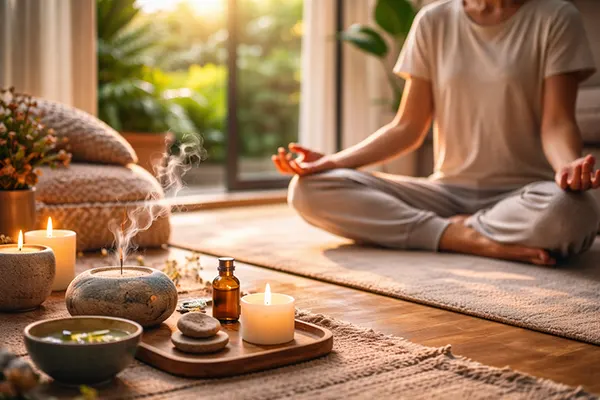
Minute 1–2: change the environment slightly. Put your phone face down, dim one light, and sit with both feet on the floor. This is not about comfort; it is about sending a clear “transition” signal. If you repeat it daily, your body starts responding before you even begin the next step.
Minute 3–6: paced breathing with longer exhale. Keep it simple: inhale gently through the nose, then exhale a little longer than you inhaled. Do not chase a perfect count. Aim for smoothness, not performance. If you feel lightheaded, slow down and make breaths smaller. The goal is to give your system a steady rhythm it can accept.
Minute 7–10: a single, quiet task. Choose one: tidy one surface, make a warm drink, stretch the neck and shoulders slowly, or write a short “brain dump” list. Stop at 10 minutes even if it feels unfinished. The fixed ending teaches your nervous system that the ritual is safe, contained, and repeatable.
Designing a ritual that stays helpful in real life
A ritual should be realistic on your worst day, not your best. If it requires special equipment, a perfect mood, or thirty minutes of silence, it will collapse under normal life. The calming effect comes from repeatability. In 2026, with packed calendars and unpredictable messages, the best rituals are short, portable, and forgiving.
Start by choosing a trigger you already have: finishing work, arriving home, after lunch, before bed. Attach the ritual to that trigger so you do not rely on motivation. Then keep the steps few and physical. The body is easier to lead than the mind when stress is high. Over time, the trigger itself becomes a cue for calm because it predicts the ritual.
Finally, watch for a common failure mode: turning rituals into rules. If you treat a ritual as mandatory or “the only way” to feel okay, it can start creating anxiety. A healthy ritual is a tool, not a test. If you miss a day, you simply return the next time without guilt, and you keep the script flexible enough to fit travel, social plans, and changing seasons.
How to check whether your ritual truly works
Use simple markers. Before and after the ritual, rate your tension from 0 to 10 and note one body signal: jaw tightness, shoulder lift, stomach flutter, or headache pressure. If the number drops by even one point reliably, you have something useful. Calm does not need to be dramatic to be real.
Look for behavioural signs too: fewer impulsive checks of your phone, slower speech, less snapping in conversations, or easier transitions into the next task. These signs often show up before you “feel relaxed”. If you track sleep, notice whether you fall asleep faster on days you repeat the evening version of your ritual.
If a ritual stops working, adjust one variable rather than starting over. Change the location, shorten the duration, or swap the final task. Keep the core cue and the core rhythm. The aim is not novelty; it is reliability. When your ritual remains easy to repeat, it keeps its calming power even during busy weeks.