
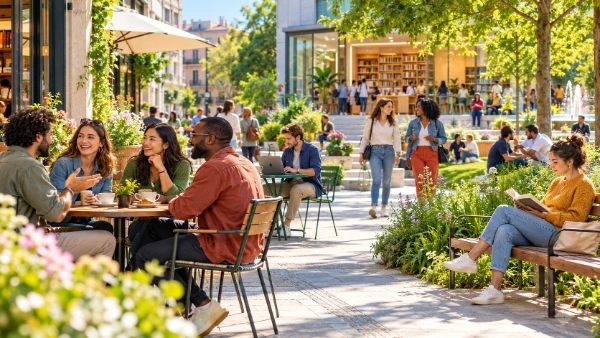
Third Places Are Returning: Why People Are Spending Free Time Beyond Home and Work Again
For several years, everyday life became increasingly concentrated around two locations: home and work. Remote employment blurred the boundary between them even further, while shopping, entertainment, food delivery and social contact became easier to manage without going anywhere at all. By 2026, however, another pattern is becoming increasingly visible. Cafés, libraries, parks, community centres, pubs, bookshops, sports clubs and similar shared spaces are taking on renewed importance. Sociologist Ray Oldenburg popularised the term “third place” for informal settings that sit outside the first place, home, and the second place, work. Their renewed relevance is not simply a nostalgic return to old habits. Hybrid working, persistent loneliness, screen-heavy routines, changing ideas about leisure and a renewed appetite for casual human contact are giving people practical reasons to spend more of their free time around others without committing to a formal event.
Why Third Places Matter Again in 2026
The attraction of a third place is partly its ordinariness. Meeting a friend in a café, reading for an hour in a library, sitting in a neighbourhood park or spending an evening at a local pub requires much less organisation than a concert, holiday or ticketed attraction. People can arrive alone, stay for a short period and still feel part of a wider social environment. That distinction matters after years in which many daily activities became increasingly private and scheduled. Social life does not depend only on close friendships or major occasions. Familiar faces, brief conversations and simply being around other people also form part of everyday social connection. Third places make those low-pressure encounters possible because participation does not normally require an invitation, membership of a friendship group or a detailed plan.
Current loneliness figures help explain why this function has become more noticeable. The UK Government’s Community and Engagement Survey for 2025/26 found that 7% of people aged 16 and over in England said they felt lonely often or always. The rate was higher among younger adults: 9% for people aged 16 to 24 and 8% among those aged 25 to 34. These figures do not mean that going to a café or joining a local activity automatically solves loneliness, and social isolation has many causes. They do show, however, that a meaningful share of the population lacks regular connection. Spaces where contact can happen naturally therefore have a different significance from purely transactional places where people arrive, complete a task and leave.
There is also a practical reaction against leisure that happens almost entirely through a screen. Streaming, social media, gaming, delivery services and online shopping remain deeply embedded in everyday life, but convenience does not always provide variety. Spending an evening moving between a laptop, television and phone can feel remarkably similar to a working day spent in front of the same devices. Leaving home creates a physical separation between activities. A short trip to a café, library, gym, park or community venue changes the surroundings, introduces other people into the day and gives leisure a clearer beginning and end. The appeal is less about rejecting technology than restoring a distinction between being online and actually going somewhere.
Hybrid Work Has Changed What “Going Out” Means
Remote and hybrid working have altered the geography of daily life. Someone who previously travelled to a workplace five days a week automatically encountered commuters, colleagues, shop staff and other familiar faces. A person working from home may have greater flexibility but far fewer incidental interactions. That trade-off is now better understood. A 2026 study of 225 remote workers in Australia found that 51% had worked somewhere other than their home or employer’s office during the previous two months. Cafés had been used by 25% of respondents and libraries by 16%, while 22% said they regularly spent at least half a day each week working from a café, library or commercial coworking space. The study is Australian rather than British, so it should not be treated as a direct measure of UK behaviour, but it illustrates how working life is spreading across a wider range of settings.
This shift also changes the role of leisure spaces. A café can be somewhere to meet a friend at the weekend and somewhere to spend an hour between appointments on Tuesday. A library can combine reading, study, remote work, children’s activities and community events within the same building. Parks may function as walking routes, lunch spots and informal meeting places. The boundaries between working, socialising and personal time are therefore less rigid than they once were. What makes a third place valuable is often not a single purpose but the ability to support several ordinary activities without demanding a major commitment from the visitor.
At the same time, people are becoming more selective about where they spend that time. Reliable Wi-Fi and charging points may matter during the working day, but comfort, noise level, accessibility, opening hours and the feeling of being able to remain without pressure are just as important. The 2026 remote-work study found that libraries were appreciated for quietness, affordability and a sense of community, while privacy and limited opening hours could be drawbacks. Cafés offered a different balance, providing atmosphere and easy access to food and drink but sometimes less reliable connectivity or more noise. There is no single ideal third place. The revival is happening precisely because people can choose settings that suit different moments of the week.
The Spaces Benefiting from the Return of Social Leisure
Public libraries provide one of the clearest examples of an established institution taking on renewed relevance. In England, the Government’s Participation Survey for April 2024 to March 2025 found that 31% of adults had engaged with library services during the previous 12 months, up from 21% in 2021/22. Physical engagement rose from 15% to 26% over the same period. Borrowing and browsing books remained the most common reason for visiting, but libraries now support a much wider mix of uses. Among adults who had visited physically, 26% had used free Wi-Fi, computers or printing facilities. Many branches also host reading groups, children’s sessions, local advice services, study areas and community events, allowing people with very different reasons for visiting to share the same public space.
Cafés have a different advantage: they are built around informal stays rather than a tightly defined activity. Buying a coffee gives someone a legitimate reason to sit alone, meet another person or spend time between other commitments. That flexibility is particularly useful in towns and city neighbourhoods where residents may not have much private space at home. A good café does not need to turn every visitor into a highly social customer. Its value as a third place comes from allowing different levels of participation. One person may talk to staff and regular customers, another may read quietly, while two friends can meet at the next table. They share an environment without needing to share the same purpose.
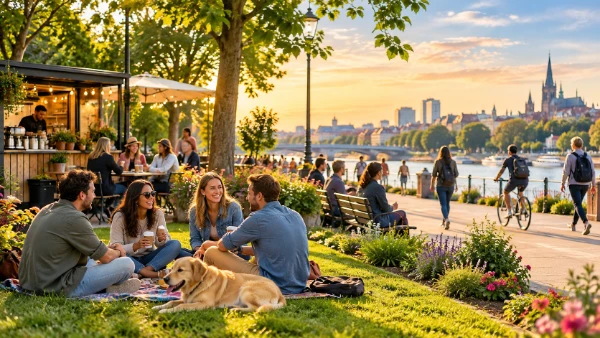
Parks, public squares, leisure centres, markets, pubs, faith buildings, hobby clubs and community halls extend the same principle in different ways. Outdoor spaces have the obvious advantage of being available without requiring a purchase, although weather, safety, seating and accessibility influence how useful they are. Sports and hobby venues provide more structured interaction, which can be helpful for people who find unplanned socialising uncomfortable. Pubs remain important social settings in Britain, but they are only one part of the picture, particularly as drinking habits differ considerably by age and lifestyle. What matters is diversity. A neighbourhood with several types of third place gives residents more ways to participate in public life than one where nearly every social activity depends on spending significant money.
Why Affordability and Accessibility Have Become Central
The renewed interest in shared spaces is happening during a period when household budgets remain an important consideration. That makes the cost of leisure more visible. Large entertainment events, restaurant meals and travel can require advance planning and substantial spending, whereas many third-place activities have a low entry cost or none at all. A library visit, walk through a park or community event can fill part of an afternoon without turning leisure into a major purchase. Even commercial settings such as cafés can provide a comparatively modest way to spend time outside the home, although expectations around how long customers can reasonably occupy a table differ from one venue to another.
Affordability also affects who gets to participate. If every comfortable shared space requires repeated spending, people on lower incomes have fewer opportunities simply to be around others. Public libraries are especially important in this respect because access to the building is normally free. The same applies to well-maintained parks, public squares and many council-run spaces. Their social value is difficult to measure only through visitor spending because much of what they provide is precisely the opportunity to stay without being pushed towards continual consumption. A teenager studying after school, an older resident reading the newspaper and a remote worker using Wi-Fi may be receiving very different benefits from the same room.
Physical accessibility matters just as much as price. A third place is most useful when it can become part of a normal routine rather than a special journey. Walking distance, public transport, safe routes, toilets, seating, step-free access and suitable opening times all affect whether people return regularly. Opening hours can be particularly important for libraries and community buildings, while parks need lighting, maintenance and usable seating to feel welcoming beyond ideal weather conditions. These details may sound mundane, but third places succeed through repetition. The neighbourhood café remembered by staff, the weekly library visit or the Saturday morning market becomes socially meaningful because people can return often enough to recognise others and be recognised themselves.
What People Are Really Looking for Beyond Home and Work
The renewed appeal of third places should not be confused with a sudden desire for constant conversation. Many people want what might be called social proximity rather than active socialising: the ability to spend time alone without feeling isolated. Reading in a busy café, working at a library desk or sitting in a park provides a background level of human presence that a private room cannot reproduce. There is no requirement to introduce yourself to everyone nearby. Yet repeated visits may gradually produce familiar faces, greetings and brief conversations. These weak social ties are different from friendship, but they can still make a neighbourhood feel more personal and reduce the sense that daily life consists only of private households and formal appointments.
People are also looking for routines that create boundaries. When home has to serve as bedroom, office, dining room and entertainment space, days can become repetitive even when there is no obvious problem with the home itself. Leaving for an hour or two creates a transition. The destination does not have to be remarkable. In fact, the most successful third places are often deliberately ordinary: somewhere close enough to visit frequently and comfortable enough that the visitor does not have to turn the outing into an occasion. This helps explain why small habits such as a regular coffee, evening class, library visit, swimming session or weekend market can have greater long-term value than occasional elaborate plans.
Another attraction is the opportunity for unplanned experience. At home, entertainment is increasingly personalised: recommendation systems select films, music, products and posts based on previous behaviour. A shared physical environment is less predictable. Someone may notice a community noticeboard, hear live music from another room, pick up a book they had not intended to read, see an exhibition, encounter a neighbour or decide to join an activity after seeing it in person. None of these moments needs to be dramatic. Their value lies in interrupting a highly controlled routine and exposing people to places, information and other people they did not specifically request.
The Return of Third Places Is About Choice, Not Nostalgia
It would be easy to describe the trend as a return to life before remote work, smartphones or home streaming, but that misses what has actually changed. People have not abandoned digital convenience, nor are most remote employees attempting to recreate a five-day office week in a coffee shop. Instead, many are assembling more flexible routines from several locations. Home remains useful for privacy and comfort; workplaces provide professional contact; third places add atmosphere, local connection and a change of scene. The important development is that people increasingly understand these settings as complementary rather than competing choices.
For towns and neighbourhoods, this makes the quality of shared everyday spaces more consequential. A lively high street cannot depend solely on retail transactions, particularly when many purchases can be made from home. Libraries, food venues, public seating, markets, cultural spaces, leisure facilities and community activities give people reasons to stay rather than simply complete an errand. The effect can reinforce itself: regular footfall supports local businesses, visible activity can make streets feel more inhabited, and repeated encounters help residents develop familiarity with an area. Not every venue needs to become a community hub, but places that allow people to remain comfortably can contribute more to local life than spaces designed only for rapid turnover.
By 2026, the renewed relevance of third places is therefore less a passing leisure trend than a practical response to how everyday routines have changed. Hybrid work has reduced some automatic social contact, loneliness remains a measurable concern, and a large share of entertainment can now be consumed without leaving home. Against that background, cafés, libraries, parks, clubs and other shared settings provide something simple but difficult to reproduce online: a reason to be physically present among other people without needing a formal occasion. The strongest third places do not force interaction or prescribe how visitors should spend their time. They make room for reading, talking, working, resting, watching and occasionally meeting someone new. That freedom is precisely why ordinary shared spaces are becoming important again.