
Art inspired by card games
Card entertainment has long attracted attention far beyond the circle of people who actually play cards. For artists, card games have provided a convenient way to depict social interaction, leisure, competition and human behaviour within a familiar everyday setting. A table with cards can bring several characters together in a single scene while allowing the artist to explore gestures, expressions and relationships between them. Depending on the period and artistic approach, such scenes may reflect ordinary recreation, tension between participants, differences in social status or broader observations about society. This connection between card games and visual art developed over centuries, which is why card-related scenes can be found in works belonging to very different artistic traditions. Art lovers can therefore encounter the culture surrounding card games not only through the games themselves, but also through paintings in which artists interpreted this familiar activity in their own distinctive ways.
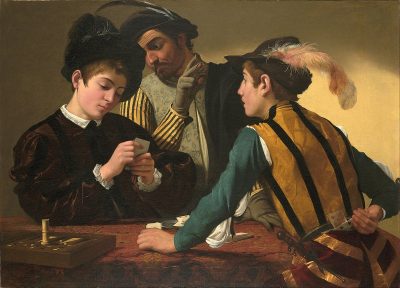
“Card cheats”, Caravaggio (1594)
In the age of online board games, it’s hard to imagine that in the 1500s, the artist Caravaggio depicted in one of his works, which he called “Card Cheats”, three men around a table at which a card game was played. One of them hides the card behind him, and the other, located behind the player, shows his cards to the cheater.
“Card Players”, Cezanne (1890)
This legendary oil painting is on display at the Musée d’Orsay in Paris and depicts two peasants playing cards on a table that appears to be in a tavern. In the painting, you can see a bottle in the background, and one of the men smoking a pipe. A version of this work was sold in 2011 to the royal family of Qatar. It is estimated that the amount paid was 250 million dollars!
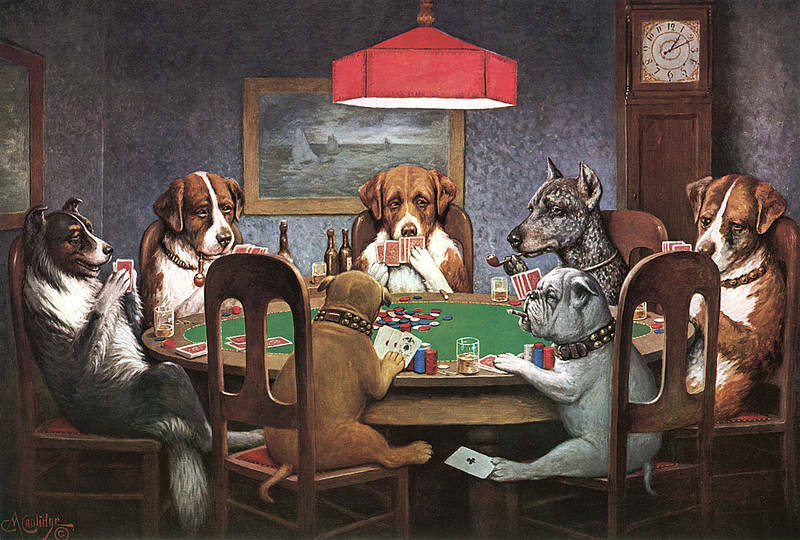
“Dogs Playing Poker”, Cassius Marcellus Coolidge (1910)
The works in the series “Dogs Playing Poker” by American artist Cassius Marcellus Coolidge are known throughout the world and to this day inspire many artists to create stories that appear in films, theaters and various other forms of artistic production. For example, in one series, dogs play cards in the same way that many people do – they drink, smoke and talk.
“Soldiers playing cards”, Fernand Léger (1917)
Léger was a French Cubist painter who was greatly influenced by the art of Cezanne and Picasso. In this work, the author expresses post-World War I mechanization through robotic soldiers, in the best Cubist style of playing cards. Industrial aesthetics is also present in the painting of this artist. The work was completed while Léger was in the hospital recovering from participation in the Battle of Verdun.