
Analogue Hobbies Are Back: Why Film Cameras, Knitting, Scrapbooking and Paper Journals Matter Again in 2026
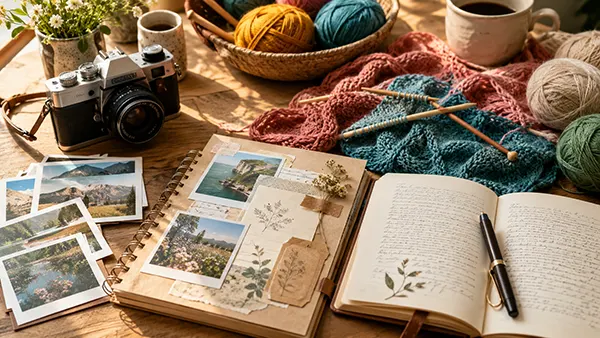
In 2026, some of the most noticeable lifestyle trends are happening far away from new apps, faster devices and constant notifications. Film cameras are appearing at parties and on city breaks, knitting has moved into cafés and social craft groups, scrapbooks are being built from printed photographs and ticket stubs, and paper journals are returning to bags that once carried little more than a phone and charger. This is not a wholesale rejection of technology. Most people who shoot film still scan their negatives, knitters share patterns online, and journal keepers often collect inspiration from social media. What has changed is the desire to spend part of the day doing something physical, limited and deliberately slower. Recent 2026 trend data supports that shift: Pinterest reported strong growth in searches connected with scrapbooking, photo albums, journalling and nature film photography, while Etsy recorded rising interest in traveller journals, memory journals and handmade textile work. The appeal is simple enough to understand: analogue hobbies give attention somewhere concrete to go, produce an object that can be held, and make leisure feel different from another hour spent looking at a screen.
Why Hands-On Leisure Feels Relevant Again in 2026
The modern day is full of small demands for attention. Messages arrive while people are working, entertainment follows them on the commute, and even quiet moments can turn into a sequence of scrolling, checking and switching between feeds. Analogue hobbies create a clear break in that pattern because they require the hands and eyes to stay with one task. Loading a roll of film, counting stitches, trimming a photograph or writing a page by hand cannot be done particularly well while also responding to several other things. That limitation is part of the attraction. Instead of promising efficiency, these hobbies make room for concentration, repetition and a pace set by the activity itself. The result is not necessarily perfect calm, and no hobby should be treated as a cure for stress, but many people value the fact that the task has a visible beginning, middle and end.
There is also a stronger appetite for leisure that leaves evidence behind. Streaming a series, scrolling short videos or playing a mobile game can be enjoyable, but the experience usually disappears when the screen is closed. A knitted scarf, a contact sheet, a filled notebook or a scrapbook page remains. That physical result gives the time spent on the hobby a different character. It can be worn, stored, given away, displayed or revisited years later. This helps explain why current trend reports place so much emphasis on keepsakes, handmade objects and memory keeping. Pinterest’s 2026 Hobbies Trend Report recorded a 433% rise in searches for “diy photo album book” and a 306% increase for “scrapbooking journaling”; Etsy’s spring and summer 2026 report said searches for traveller journals had doubled and searches for memory journals were up 189%. These figures describe activity within those services rather than the entire population, but they show where curiosity and spending interest are moving.
Nostalgia matters too, although it is only part of the story. For older adults, film photography, knitting patterns and paper diaries may reconnect with familiar routines from before smartphones became central to everyday life. For younger people, the same objects can feel new because they were never ordinary in the first place. A disposable camera does not simply imitate a phone camera with lower image quality; it changes the behaviour around taking photographs because each frame is limited and the result is delayed. A paper journal is not merely a slower notes app; it is a private space without alerts, metrics or an audience. The most successful analogue hobbies in 2026 tend to offer this combination of familiarity and novelty, linking inherited techniques with a generation that is using them for its own reasons.
Slower Hobbies Replace Constant Choice with Useful Limits
Many screen-based activities offer almost unlimited choice, which sounds convenient but can make leisure surprisingly restless. There is always another video, another photograph to edit, another tab to open or another recommendation to consider. Analogue hobbies reduce those options. A 36-exposure film roll has a fixed number of frames. A knitting project is shaped by the yarn, needles and pattern already chosen. A scrapbook page has only so much physical space. A notebook has a beginning and an end. These boundaries encourage commitment to small decisions instead of endless comparison. They also make mistakes more visible: a slightly blurred photograph, uneven stitches or a crooked piece of paper may remain part of the finished object rather than being instantly deleted. For many hobbyists, that imperfection is not a defect but proof that the object was made rather than generated or endlessly corrected.
Delayed results are another important part of the attraction. Film may take days to be developed, a knitted garment can require weeks of occasional work, and a journal becomes meaningful through accumulation rather than instant completion. That is a sharp contrast with services designed to provide immediate feedback. Fujifilm has explicitly linked the renewed interest in its QuickSnap film cameras to delayed gratification and a wish for a better balance between screen time and physical experiences. In July 2026, the company marked the 40th anniversary of QuickSnap by announcing new waterproof and black-and-white versions for European release from September. The commercial decision does not prove that everyone is moving back to film, but it does show that a major photography manufacturer sees enough sustained demand to expand an analogue product line rather than treat it as a museum piece.
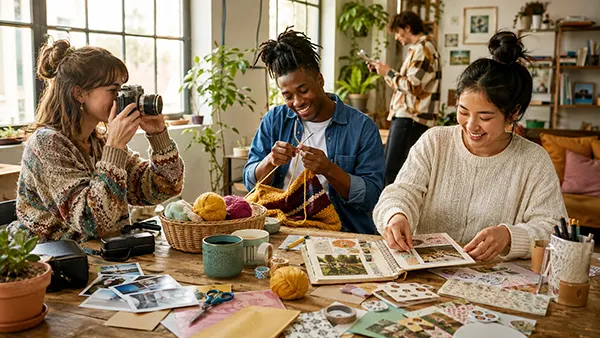
The social side of these hobbies is also changing their image. Knitting and crochet are no longer confined to solitary evenings at home; younger makers meet in cafés, attend workshops, join local craft circles and trade patterns or yarn with friends. Reports from 2025 and 2026 have documented young adults using traditional crafts and other screen-free activities as a way to spend time together without centring the gathering on a phone. The same pattern can be seen in zine events, journalling meet-ups, photo walks and scrapbooking sessions. In practice, analogue leisure is often mixed with modern communication: people may arrange a knitting group through a messaging app or post scanned film photographs afterwards. The key difference is that the shared activity itself happens in the room, with materials, conversation and a task that does not require constant online participation.
Film Photography and Knitting Have Become Creative Counterweights
Film photography is one of the clearest examples of an old format finding a new audience without replacing its modern equivalent. Smartphones remain the everyday camera for most people because they are fast, capable and always nearby. Film offers something different: scarcity, uncertainty and a distinctive process. A photographer has to choose a film stock, work with a fixed sensitivity, think more carefully about each exposure and wait to see the final images. None of this makes film objectively better, and the cost of buying and developing film can be substantial. Yet those constraints can make an ordinary outing feel more intentional. The popularity of instant photography points in the same direction. Fujifilm reported in 2025 that cumulative sales of its instax range had passed 100 million units worldwide, while the company’s 2026 QuickSnap expansion shows continued investment in physical photography for casual users as well as enthusiasts.
The renewed visibility of film in professional culture also keeps the medium from feeling obsolete. Kodak reported that 20 productions shot on its film stocks screened at the 2026 Cannes Film Festival, including 12 captured on 35mm and eight on 16mm. That is cinema rather than everyday photography, but it reinforces film’s place as a living creative medium rather than a purely retro effect. For hobby photographers, the appeal is more modest and personal. A roll may contain a birthday, a weekend away and a few ordinary street scenes, all preserved with the colour, grain and occasional flaws created by the camera and processing. Because the images cannot be reviewed immediately, people often remember the circumstances around them differently; receiving developed photographs can feel like revisiting an event rather than merely opening another folder.
Knitting and crochet offer a similar mixture of tradition and personal control. The basic techniques are old, but the projects circulating in 2026 range from classic jumpers and socks to colourful bags, small accessories, visible mending and experimental garments. Etsy’s spring and summer 2026 trend report described crochet, embroidery and stitched textures as a notable direction and recorded a 36% rise in sales for crochet clothing. Pinterest’s 2026 hobbies report also showed strong search growth around crochet upcycling and medieval knitting, suggesting that people are not simply reproducing old patterns but adapting craft skills to contemporary tastes. The practical barrier to entry is relatively low: a beginner can start with yarn, needles or a hook and a small project, then decide later whether the hobby deserves more time and money.
Why the Process Matters as Much as the Finished Result
Film photography makes people negotiate with chance. Light changes, focus can be missed, a subject may move, and the final frame may look different from the image imagined at the moment of pressing the shutter. That uncertainty encourages attention before the picture is taken. It also reduces the temptation to produce dozens of nearly identical shots simply because storage is effectively unlimited. For beginners, this can be frustrating, so the best entry point is usually simple equipment rather than an expensive vintage camera with unfamiliar controls. A tested point-and-shoot camera or a single-use camera can teach the basic rhythm of film without turning the hobby into a technical project. Development costs should be checked locally before buying several rolls, as processing and scanning prices vary widely between labs and cities.
Knitting rewards repetition in a different way. The same movement is performed hundreds or thousands of times, but the fabric changes slowly in the hands. Beginners often assume the main goal is to finish a wearable item as quickly as possible, yet much of the satisfaction comes from learning how tension, yarn and stitch choice affect the result. Small early mistakes are normal, and inexpensive starter materials are often better than luxury yarn for practice because they remove the pressure to produce something flawless. A scarf, simple hat, dishcloth or small pouch can be more useful as a first project than a complicated jumper. Once the basic movements become familiar, patterns that initially look like a code become easier to read, and the hobby opens into colourwork, texture, garment construction, repairs and original designs.
Both hobbies also challenge the idea that every interest needs to become productive or profitable. A person can take film photographs that are never posted, or knit an object that would have been cheaper to buy. The point is not to beat industrial production on price or to build an audience. The value lies in the time spent learning, noticing and making decisions that have visible consequences. This is one reason handmade objects can feel disproportionately meaningful compared with their material cost. A pair of knitted socks represents hours of work; a small set of film prints represents a finite number of chosen moments. In 2026, when automated tools can generate images, text and designs almost instantly, the slow evidence of personal effort has become part of the appeal rather than an inconvenience to be removed.
Scrapbooking and Paper Journals Turn Ordinary Life into a Physical Record
Scrapbooking has benefited from the same shift towards tangible memory keeping, but the modern version is often less formal than the heavily decorated albums associated with earlier craft trends. A 2026 scrapbook might combine instant photographs, cinema tickets, labels, receipts, pressed flowers, handwritten notes, packaging, maps and small pieces of printed ephemera. The purpose is not necessarily to create a polished family archive. Many people use scrapbooks as visual diaries, travel records, music journals or collections built around a single year, friendship or interest. Pinterest’s August 2026 data is especially relevant here: searches for scrapbooking journalling rose 306%, DIY photo album books rose 433%, dream journalling rose 156% and music journalling rose 128%. These are search trends rather than population statistics, but together they show strong interest in personal documentation that exists as an object rather than only as a cloud folder.
Paper journals are returning for equally practical reasons. Writing by hand creates more friction than typing, and that can be useful when the goal is reflection rather than speed. A notebook does not need to sync, update or send reminders. It can hold plans, observations, sketches, lists, pasted photographs and private thoughts in the same place without requiring a format to be chosen in advance. Some people use a daily diary, others keep a weekly planner, a reading log, a travel notebook or a commonplace book for quotations and ideas. Etsy’s 2026 trend data recorded doubled searches for traveller journals, alongside strong growth for journal charms, leather journal covers and memory journals. The products themselves are not the main story; the interesting part is the return of the handwritten ritual, especially among people who already manage much of their work and social life through screens.
Scrapbooks and journals also offer a different relationship with personal history. Phone galleries can contain tens of thousands of photographs, but the volume makes selection difficult. A paper album forces the maker to choose a small number of images and decide what deserves space beside them. A diary does something similar with events and thoughts. Over time, those choices create a record shaped by attention rather than automatic storage. The record is incomplete, but that incompleteness can make it more personal. A coffee receipt kept because the conversation mattered, a badly exposed photograph from a rainy trip or a page written in hurried handwriting may later carry more meaning than a technically perfect image that was never printed. The physical wear of the object becomes part of its history as well.
How to Start an Analogue Hobby Without Making It Another Obligation
The easiest way to begin is to keep the first version of the hobby deliberately small. For film photography, one camera and one roll are enough to learn what the process feels like. For knitting, a straightforward project with affordable yarn is more sensible than buying a large set of tools before learning the basic stitches. A scrapbook can start with a plain notebook, glue and a handful of printed photographs, while a paper journal needs nothing more than a pen and pages that feel comfortable to write on. This matters because analogue hobbies can become surprisingly consumption-heavy when people focus on accessories before they have formed a routine. Vintage cameras, premium stationery, specialist scissors, decorative tapes and expensive yarn can all be enjoyable, but none is required to test whether the activity genuinely fits a person’s life.
It also helps to choose a purpose that is concrete but not demanding. A camera might be reserved for weekends or family gatherings. A knitting project can live beside the sofa and be picked up for twenty minutes at a time. A scrapbook could document one trip instead of an entire year, and a journal can be used a few times a week rather than every morning without exception. The point of the analogue revival is easily lost when a hobby turns into another streak to maintain or another performance to display. Missing a day, abandoning a project or producing something untidy does not mean the hobby failed. In fact, the lack of automated reminders and public progress measures is one of the qualities that makes these activities useful as leisure.
The return of analogue hobbies in 2026 is therefore less about pretending modern technology never happened and more about giving it some competition for attention. Film cameras, knitting, scrapbooking and paper journals all ask for time in exchange for something physical: a photograph that had to be waited for, fabric built stitch by stitch, a page assembled by hand or a sentence written without predictive text. Current search and retail trends show that interest in these activities is real, especially among younger users, but their staying power will depend on something more ordinary than fashion. They are satisfying because they make people participants rather than spectators. In a routine filled with instant access and endless content, choosing one finite task and making something slowly can feel unexpectedly contemporary.