
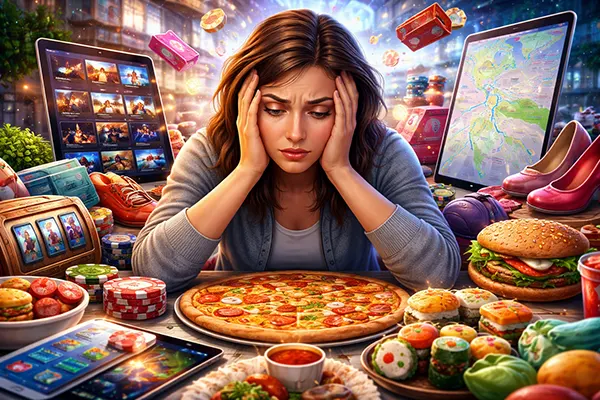
Cognitive Fatigue from Choice: Why Too Many Options Drain Us More Than Work
Modern daily life is filled with constant decisions, many of which seem trivial at first glance. Choosing what to eat, what to watch, which route to take, or even which game to play can quietly accumulate into a significant mental load. This phenomenon, known as decision fatigue, reflects how the brain’s ability to make choices deteriorates after prolonged use. Unlike physical tiredness, it often goes unnoticed, yet it directly affects behaviour, impulse control, and even financial decisions.
The Psychology Behind Decision Fatigue
Decision fatigue is rooted in the brain’s limited cognitive resources. Every choice, regardless of its importance, consumes mental energy. Studies in behavioural psychology have shown that the prefrontal cortex — responsible for planning and decision-making — becomes less efficient after repeated use. By the end of the day, people are more likely to avoid decisions altogether or rely on shortcuts.
This is why individuals often default to familiar options when tired. In practical terms, it means ordering the same meal, watching familiar shows, or sticking to habitual routines. While this behaviour simplifies decision-making, it also reduces engagement with new experiences and limits critical thinking.
The paradox is that more options do not necessarily lead to better outcomes. On the contrary, excessive choice increases cognitive strain. Instead of feeling empowered, individuals feel overwhelmed, which can lead to procrastination, dissatisfaction, or poor decision quality.
How the Brain Reacts to Excessive Options
When faced with too many alternatives, the brain enters a state of cognitive overload. Instead of evaluating each option carefully, it begins to filter information aggressively. This filtering process is not always rational and often prioritises convenience over accuracy.
Neuroscientific research suggests that excessive choice activates stress-related responses. Cortisol levels can rise when individuals feel pressured to make the “best” decision among many. This stress further reduces the ability to evaluate long-term consequences.
As a result, people may either rush into decisions or avoid them entirely. Both outcomes are inefficient. Rushed decisions increase the likelihood of regret, while avoidance leads to missed opportunities and prolonged mental tension.
Everyday Situations Where Choice Becomes Exhausting
Decision fatigue is not limited to complex scenarios. It appears in everyday situations such as scrolling through streaming services, selecting meals from extensive menus, or choosing travel routes. These small decisions accumulate, gradually draining mental resources.
Streaming platforms are a clear example. With thousands of titles available, users often spend more time choosing what to watch than actually watching it. The abundance of options creates pressure to select the “right” choice, turning leisure into a mentally demanding task.
Even navigation apps contribute to this fatigue. Multiple route suggestions, each with slight variations, force users to analyse trade-offs constantly. Over time, this continuous evaluation reduces cognitive efficiency and increases stress.
The Paradox of Choice in Digital Environments
Digital environments amplify the paradox of choice. Unlike physical spaces, where options are naturally limited, online systems can present nearly endless alternatives. This abundance creates an illusion of freedom while increasing cognitive burden.
Research has shown that when people are presented with fewer options, they are more likely to make decisions quickly and feel satisfied with their choice. In contrast, a larger selection often leads to second-guessing and regret, even after making a decision.
This effect is particularly visible in gaming and entertainment. When players are offered too many modes, features, or rewards, engagement may decrease. Instead of enhancing the experience, complexity becomes a barrier.

Behavioural Impact: From Daily Habits to Gambling Decisions
Decision fatigue significantly influences behaviour, often pushing individuals towards impulsive actions. When cognitive resources are depleted, self-control weakens. This can result in overspending, unhealthy eating, or excessive screen time.
In the context of gambling or gaming, the impact becomes even more pronounced. After making multiple decisions throughout the day, players are more likely to rely on intuition rather than analysis. This increases risk-taking behaviour and reduces the ability to evaluate odds objectively.
Fatigue also affects persistence. Individuals may continue playing or making decisions not because of strategic reasoning, but because their ability to stop has diminished. This pattern is closely linked to emotional rather than rational decision-making.
How to Reduce Cognitive Load in a World of Endless Choices
One of the most effective strategies is to limit the number of daily decisions. Creating routines, such as standard meals or fixed schedules, helps preserve mental energy for more important choices. Many high-performing individuals rely on structured habits for this reason.
Another approach is to simplify decision environments. Reducing available options, using filters, or setting predefined criteria can make choices faster and more efficient. For example, narrowing down entertainment options before browsing reduces cognitive strain.
Finally, recognising the signs of decision fatigue is crucial. Delaying important decisions until the mind is rested can significantly improve outcomes. Awareness alone allows individuals to distinguish between genuine preferences and choices driven by exhaustion.